

Current Issue
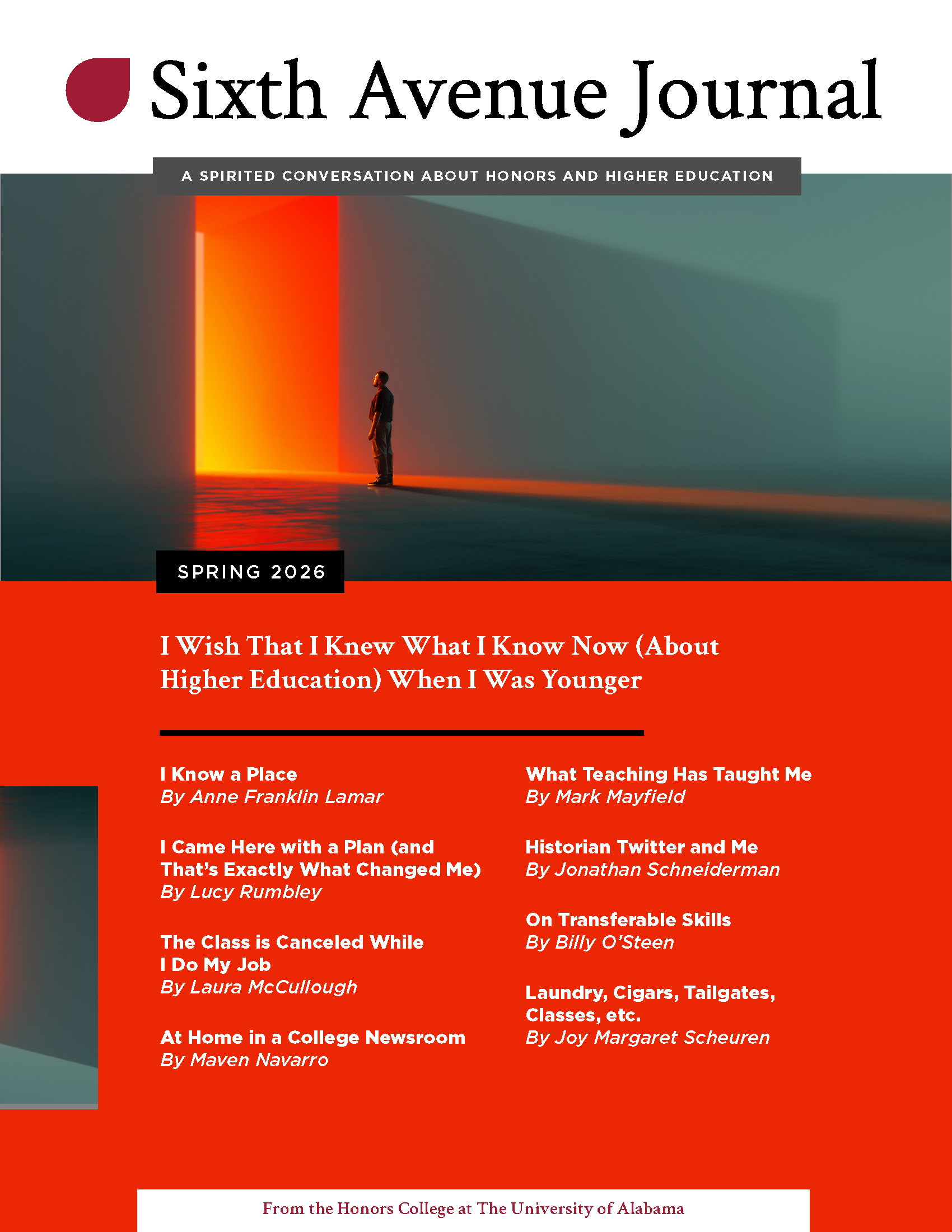
The Journal’s mission is revealed in its format. There is a reliance on—and a comfort with—the conversational voice, plain speaking, and thinking out loud to effectively present the lives and thoughts of faculty and students in higher education to an American public that is, at best, uncertain when it comes to us. And to each other. Thoughtful, persuasive conversations have been widely abandoned in this digital and social media age and lesser, clumsier forms of exchange unstoppably shoved into their place. To generate public conversations about life in academia, the Sixth Avenue Journal calls for short, thoughtful personal essays, clear, transparent, delivering a talking to-your-friends story. Maybe a little outspoken. No stiff stuff, no academic writing rituals, detailed citations or dense academic flourishes. Not too many big words. The vernacular and unguarded moments sought. Elegantly crafted and argued. But no social media styling: We don’t do that.
Articles
Hello.
Thank you for taking the time to visit the Sixth Avenue Journal.
This journal is a new online publication about Honors education. It exists in a communication space that commonly goes unused in academia.
We are being increasingly convinced to converse in truncated and/or inadequate digital languages. And that means that the potential of satisfying conversation, dialogue, and discourse about our Honors world can be difficult to produce and exploit.
An Honors faculty colleague of mine told me recently: “We need a way of thinking.” My argument is that we do have a narrative of our own, but it needs more energy and its own forum to fully establish itself, to escape just being a derivative of a way of speaking emerging from how they talk across campus. And to escape being buried or hidden in academic speak. Conversations about that "way of thinking" and conversations using it, are my goal. To be blunt, I have placed this journal in that largely empty written communication world between the peer-reviewed journal and the blog.
Peer-reviewed journals are undeniably our research gold standard, and they host our most dramatic and penetrating voices in full cry. Their practices and standards dominate us. These journals have their essential rules and practices, and they provide a vehicle for the most dense, intense, and revolutionary of academic speech. But for these very reasons the peer-reviewed journal has its limitations. They can, for example, be very hard to read. I don’t intend that this journal should be an alternative place for the peer-reviewed paper, a place for a smoother, diluted version. I do intend that it be a place for thoughts that will never be a peer-reviewed article, but need to be part of our conversation.
Nor will I not compete with the blogger and the social media enthusiast. Exchanges in social media can be abrupt and mean; some participants seem to assume this is required. I am not asking for research papers, but I’m also not looking for something produced with your thumbs. I am looking for academic conversations to hold on to, or, perhaps in this age, retrieve, much of the potential of Honors professors, and other Honors people, talking to peers, whether they be in Honors Colleges or departmental Honors.
You’ll see that it’s not the peer-reviewed journals’ content I have been considering; it’s what’s not in that content, and because it doesn’t fit there it can fade away unspoken.
This journal is not a replacement, a competitor nor a substitute for a peer-reviewed publication, and not a place for lesser versions or visions of our thinking. It is a resource for the sort of thinking that commonly gets left behind in places like campus hallways and informal meetings or late-night, post-conference-session jams or ad hoc faculty meetings. I’m asking contributors to talk about their work, their ideas about teaching Honors, their experiences, theories and concerns, via spirited academic conversations. The talk might be of ideas in mid-development, Honors methodology, classroom or experiential learning possibilities that you are just beginning to process, moves that might work if administrators didn’t resist as administrators do, papers and presentations that are being worked on, work that you prize but that has found no home in faculty planning, or why a monograph or conference presentation was undertaken and its outfall. Or work you value as representative of your place in Honors but there’s no way it’s going into your P&T portfolio.
When you consider a submission, keep in mind that the purpose of the Sixth Avenue Journal is to generate conversations.
The journal will publish thinking that, in many cases, might otherwise be left to wither or be self-supressed because a style and format like ours – one that still requires adherence to academic values and substantial writing ability – might give them a place to emerge and be usefully discussed.
What’s in it for you? It’s a place to be a public intellectual who is broader than just what a search of peer-reviewed journals or conference presentations establishes, a chance to present some of your range and positions and explain your thinking. Of saying that Man Thinking is not the same as the Man Researching. Perhaps Emerson’s Man Thinking would submit some inspiring pieces. Perhaps our contributors will be more essayists than academic writers because of what the form can accomplish. Speaking of writing, our guidelines require that writing is substantial and meets the highest editorial standards. It will be subject to fact-checking and editorial policy review. Some of the digital-era thinking will rub off on us – the editorial policy aims to restrict rarely if at all.
Many of my peers tried to talk me out of this adventure. The odds weren’t good they said. They seemed to assume that once the peer-review plank is removed, all that’s left is a splash. But almost all of these discouragers concede they actually have impactful things to say, that will in all probability never get said to a wide audience in their most passionate form.
Because we operate without long delays between submission and publication there are current events or trends that can be addressed, but we can also publish substantial responses – what might be thought of as extended “letters to the editor” – so that the "conversation" happens. It’s possible we are more of a magazine than a journal, but, to that I say we are shaped by our goals. I founded the Sixth Avenue Journal here in the Honors College of The University of Alabama, as a public forum for the inspiring ideas and analyses I constantly walked into on our third floor, faculty corridor. Looking to a far wider audience is my optimism; or foolishness.
There will be podcasts profiling our contributors so you can get to know them a little. There will be writing from students addressing their Honors life, because we make so many decisions that influence them without always being in possession of adequate access to their thinking, and that, inevitably makes a difference to outcomes. And I will ask administrators to consider our brief and take the same chance writing for us that you do. I also intend to ask some of America’s best education writers for contributions.
It goes without saying we are open access. No charges for submissions or for access, it’s for all eyes. [For more detail see the About section.]
Oh, and, FYI, my future columns will be shorter.
Henry John Latta